NAGS – Naturally Adsorbed Gas Survey – unique gas geochemical
technology based on the analysis of hydrocarbon and non-hydrocarbon
gases naturally adsorbed by subsoil rocks. NAGS is designed for
prospecting of hydrocarbon accumulations and mineral deposits. NAGS
is much more informative compared with traditional geochemical prospecting
methods dealing with free form of gases. NAGS deals with gases tightly
adsorbed by subsoil rocks, so that sampling conditions’ temperature,
humidity, mass and preservation of material during transportation
are not critical. Componential composition of gases naturally
adsorbed by subsoil rocks is characteristic of fundamental geological
processes taking place in the subsurface. NAGS is applied
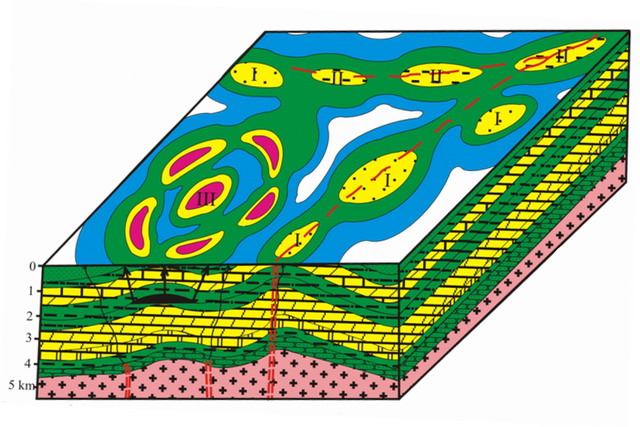
to detect HC’s and mineral deposits and produce maps of gas-geochemical
anomalies closely related to outlines of mineral deposits and HC
accumulations. In oil & gas applications
the technology produces accurate results of oil to water contact.
Superposition of independently acquired datasets of STeP and NAGS
provides a more accurate prediction of mineral potential compared
to traditional exploration technologies.
During
the NAGS process, 50-70 gram subsoil rock samples, collected at the
target area, are crushed and ground. The NAGS technology requires
that 50-70 gram subsoil rock samples are collected in the analyzed
area. They are crushed, screened, and heated to approximately 225
ºС in order to thermally desorb gas and analyze it. Composition
of thermo-desorbed gas is analyzed for С1 – С5 HC-components, О2,
N2, H2 and CO2 using a gas chromatograph unit. Adsorbed HC gases contain all the homologs of CH4 thus
allowing for application of gas characterization criteria. A
typical survey, depending on the license block size, may require
sampling of 100 to a few thousand points per target anomaly.
NAGS
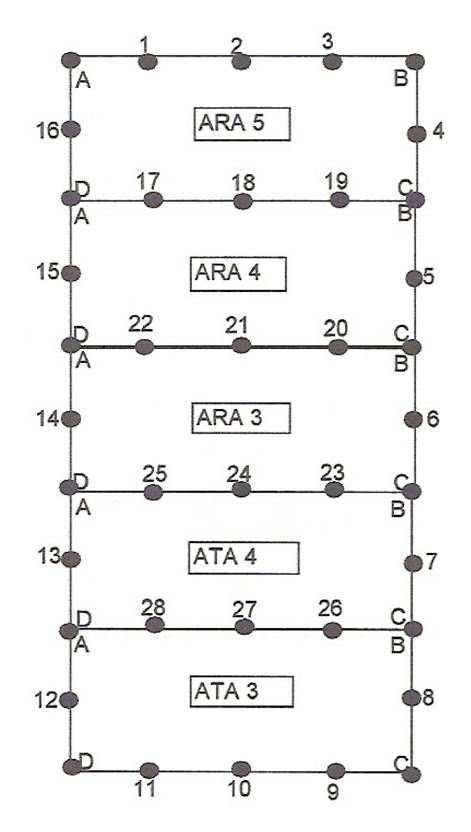
sample collection is performed in 2 to 3 stages. The first stage
may require
that samples are collected with the distance of 2 to 4 km between
the points. The second and potentially third stages, with
due regard to the first sampling, are carried out at finer spacing
of approximately 100 meters over the potential mineral or HC anomaly.
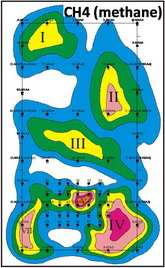
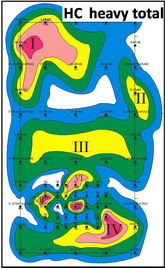
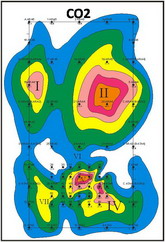
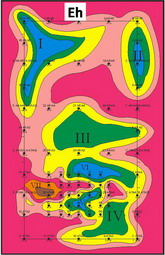
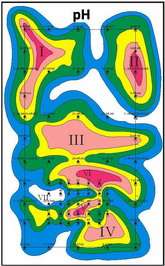
Resulting
maps depict the areal distribution of about 20 gas attributes (HC
gases, О2, N2, H2 and CO2) and Eh and pH indices. The maps
of quantitative characteristics of adsorbed HC- gases, О2, N2, H2
and CO2, Eh and pH, as well as various correlations of these attributes,
result in a conclusion about the presence and type of potential
mineral anomaly.
The results of each stage dictate the survey
strategy, identifying locations of possible anomalies and sampling
at even finer distance between points of 50 meters, if necessary.
)